|


| Species of the Month - January 2015 Flute Lichen Menegazzia terebrata
The Flute Lichen normally occurs in damp shady woods on acid-barked trees such as Birch, Alder and young to middle-aged Oak (older Oaks are more alkaline). It is important to record it where it occurs as it's an indicator of ancient woodland. We are all familiar with the many ancient woodland indicators that occur in our area on Hazels and other alkaline-barked trees, but in birchwoods there are not so many and this perhaps the easiest one to look out for.
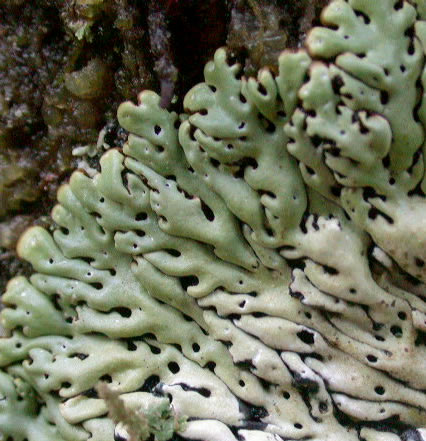
Apothecia or "fruits" are very rare on this lichen and I have never seen them. It normally reproduces by means of soralia, rounded heaps of powder on the ends of the lobes or on the lobe surface, sometimes on short stalks, as seen in the pictures above.
The lichen is a pale bluish grey when dry and greener when wet. The underside is black, and does not have any rhizines, the root-like underside growths that occur on the common non-inflated blue-grey lichens such as Parmelia, Hypotrachyna and Parmotrema species. The lobe tips are often dark brown where they begin to turn under, as in this photo.
M terebrata is a
hyperoceanic species virtually unknown in Britain away from the west
coast. It has a similar distribution to Hypotrachyna laevigata,
which is the dominant lichen on birches in our area but absent further
east where it can't cope with the drier conditions. M terebrata is
even less tolerant of any reduction in rainfall than H laevigata.
You'll see an awful lot of H laevigata while looking for M terebrata.
It's quite easy to pick out the hollow-looking lichens from the flat
Hypotrachyna and Parmelia around them, but the first hollow ones you
find will probably be Hypogymnia species. Then it's down to
finding one with holes, and you'll know you have a genuine Flute!
By filling in this form you agree that the information contained in this form may be collated and disseminated manually or electronically for environmental decision-making, education, research and other public benefit uses in accordance with the LNHG data access policy. Your email address will not form part of the record and will not be passed on to anyone.
Carl Farmer
27 January: Seen several times on LNHG visit to Glen Creran Woods, on
birch, holly and alder. Jan Hamilton spotted it first.
Dec 2014 - Giant Willow Aphid
This project is supported by Scottish Natural Heritage
|