|


| 18 January 2014 LNHG field trip, Port Appin
Not a yard into the woods and someone's already stopped to look at
lichens. Photo by Sallie.
The lichen Bunodophoron melanocarpum, or Black-eyed Susan, growing on
birch, found and photographed by Jan. The black spore-masses are
on the underside of the branch tips.
A related but much commoner lichen, Sphaerophorus
globosus, also found and photographed by Jan. This has round,
often brownish, branches rather than the flatter ones of Bunodophoron.
The black spores are in spherical capsules at the branch ends. In
the photo these have not yet opened.
Hypotrachyna laevigata is extremely common on birch but its fruits
are not. There were plenty on this specimen, however, including some monster
ones.
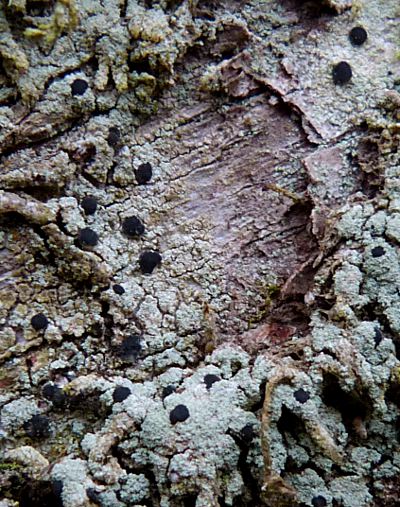
A mystery lichen found by Duri on a Birch trunk.
It's completely powdery, like Lepraria, but has large black apothecia.
I did wonder about Lecidella elaeochroma f. soralifera, but I can’t make
it that as it won’t turn orange with bleach and its spores aren’t quite
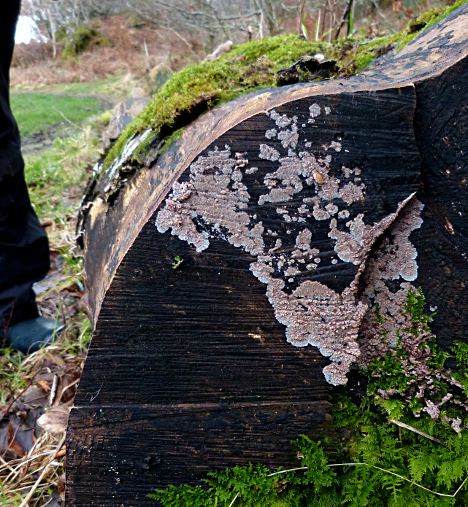
the right shape. One day I'll know what it is. On the right
is the pink encrusting fungus Phlebia rufa on a Sycamore
log, spotted by Jan.
Jan's photo of the pale moss Plagiothecium undulatum, which stood out
wherever we went in the wood.
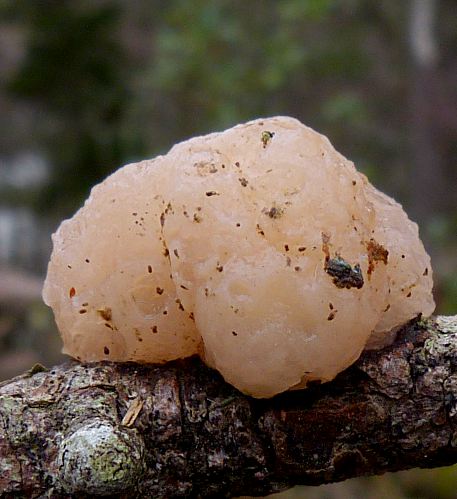
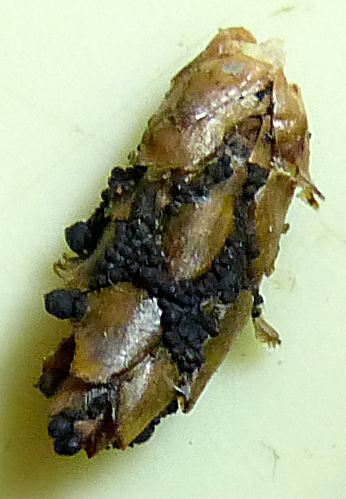
This pink jelly blob is a fearsome predator. Spotted by Duri, it's called Pink Brain Fungus (Tremella encephala), and has enveloped a fruitbody of its favourite food, Bleeding Conifer Crust (Stereum sanguinolentum), which was innocently decomposing a fallen Larch twig. So two records for the price of one there. The predator was a first for VC98 but the prey was not. On the right is an even more remarkable find. Rob
pointed out a Spruce tree covered in galled buds, each of which had
these tiny cinder fungi growing on them. I had no idea that any
fungus of this type was a gall-causer, but we learn something new on
each field trip. It's called Cucurbitaria piceae. There are
only 7 previous British records for this fungus, none since 1974 and
only one of them in Scotland.
It was a surprise to find many of the larch trees at the tip of the
headland wrapped in the wiry threads of Bryoria fuscescens, which
normally tends
to stay away from the west coast. The blue stuff on the
extreme right is an Usnea.
Sallie's photo of the view from our lunch spot.
|