|


| 25 March 2014 LNHG recording field trip along Sustrans cycle track south-east from Appin
After weeks of miserable weather the forecast was good for this outing, but very disappointingly it rained almost all the time. Despite that it was an enjoyable walk. Our aim was to add to the plant lists for two sections of cycle track (NM 9445 and NM 9545) which had not previously been surveyed in springtime. We were also hoping to add to the 354 plant taxa so far recorded for the cycle track as a whole. We added 11 new plants for the first of these sections and 6 for the second. Just one new plant for the cycle track as a whole took the total to 355.
This is it - Rumex x pratensis, the hybrid between
Broad-leaved Dock and Curly Dock. It's quite common but
under-recorded.
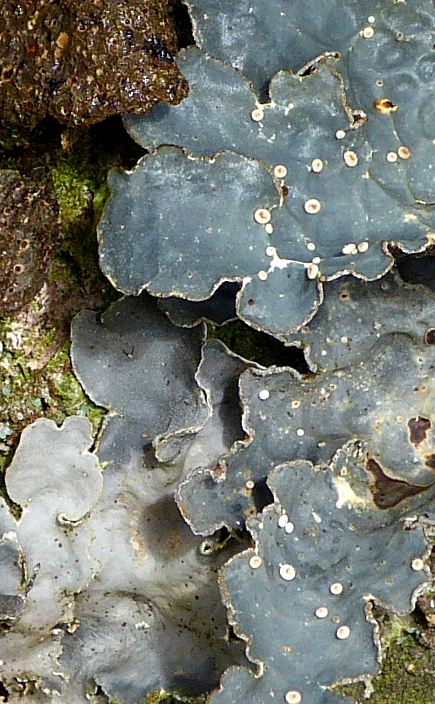
The most puzzling find of the day was this extraordinary lichen on willow. The surface has green areas and white areas, connected by areas that are white with green dots. The lip-shaped soralia on the lobe ends suggest Parmotrema perlatum, but the lichen lacked cilia and had virtually no rhizines, as well as having different chemical reactions from P perlatum. If it is P perlatum it's a very odd form of it.
In places it was richly fertile with large apothetica,
whose undersides were green with white dots. I'm awaiting the
opinion of an expert as to what it might be.
As this and the next 9 photos show, nature's artistry and Jan's
photography were made for each other.
The Dice Lichen, Pertusaria pertusa
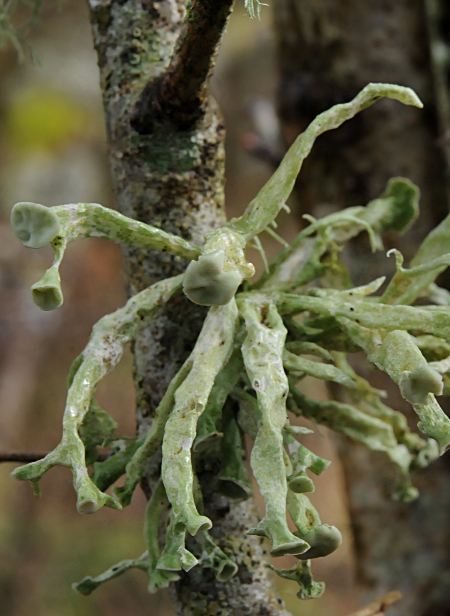
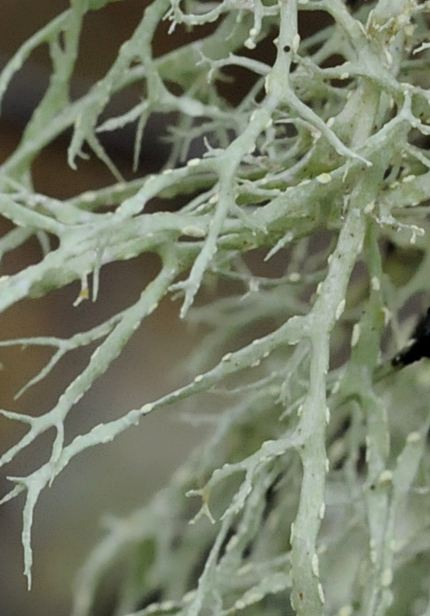
The three Ramalina species commonly found on Hawthorn: R fastigiata on the left (with terminal apothecia), R farinacea on the right (without apothecia but with powdery soralia along the sides), and R calicaris below (with apothecia on bends in the stem, which has a channelled appearance)
This specimen of R calicaris is under attack from a
black ascomycete fungus which I have not yet been able to identify (it
did not give spores). R farinacea was also affected by this fungus. |




 |
 |
The cycle track is new but the railway line was there
over a century before it, so the strips of woodland along the sides have
had time to acquire a good covering of lichens. Here are Lobaria
pulmonaria and Lobaria scrobiculata, both fertile. In the top left
of the second pic is Sticta fuliginosa infected with the lichenicolous
fungus Abrothallus welwitschii.

Jan pointed out lumps of clinker beside the track from the days of
steam.

More recent discards may have something to do with this
bright blue lichen, new to science!

Journey's end - Jan's photo of trees beside the river Iola, looking towards Beinn Donn. Here the cycle track leaves the old railway and goes alongside the road for a while, making for a less interesting walk. It also exits the second of today's target sections. Time for a brisk hike back in the rain, looking out for anything we might have missed on the way. Still no primrose!
All photos and other content
copyright © Carl Farmer except where stated. Some photos on this
page are © Jan Hamilton