|


| 28 October 2014 LNHG Midweek Field Trip, Kentallen
After days of torrential rain and floods, the weather changed completely just in time for our midweek walk along the newly-opened stretch of Sustrans Cycle Track at Kentallen. As part of our ongoing cycle track survey we recorded
all the plants we found alongside the track in the three new 1 km squares
that it passes through. There were a lot of small birds (including
a Long-tailed Tit flock) foraging
along the track which is ideal for them with its mix of ungrazed
vegetation and strips of woodland.
Looking down onto the main road from the cycle track, approaching Kentallen Bay Some larger birds were seen too: 4 Sea Eagles together in the sky above us, 2 adults and 2 juveniles, spotted and identified by Rob, and later on we saw a Sea Eagle and a Golden Eagle close together over a hilltop. But given the time of year it was fungi that
occupied most of our attention. On our 15 Oct foray the fungi
were suffering from the effects of a dry spell. This time it was
the reverse, the rain had washed off any detachable bits and left the
rest sopping wet.
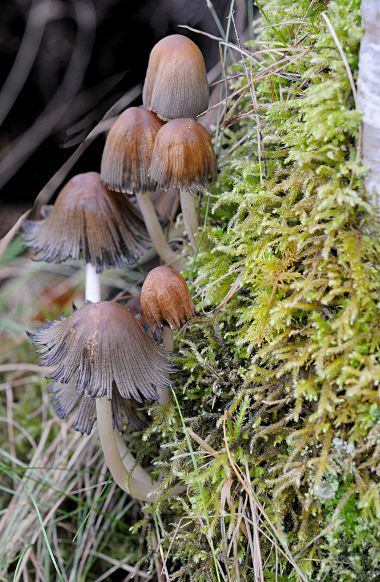
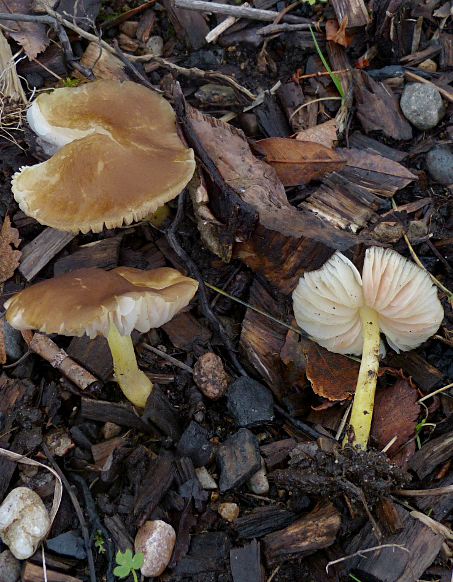
So when someone suggested Glistening Inkcap for the deliquescent fungi on the left, I examined the cap surface for "mica flakes" and, not finding any, declared that it must be a different Inkcap species. However, on examining the spores at home they were clearly those of Glistening Inkcap. The flakes must have been washed off by the rain. They were growing on and around a pile of woodchips, and further up the track some more were found at the base of a dead birch. Also on woodchips was this intriguing mushroom with
yellow stem, brown cap and gills turning pink. More detective work
- it turned out to be Pluteus romellii, the Goldleaf Shield. A new
one for me.
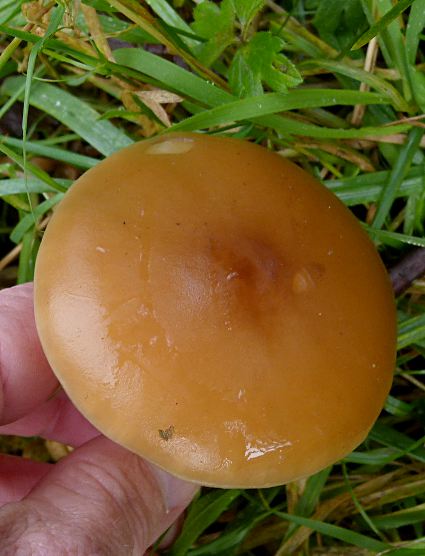
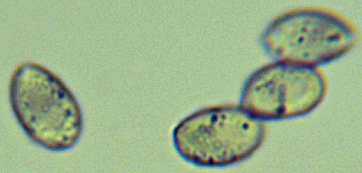
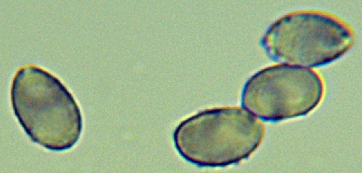
This was another puzzle. With such a buttery cap I guessed it to be the Butter Cap (Rhodocollybia butyracea), but on examination at home it clearly was not. With LNHG's superb new microscope I was able to see the unusual randomly-spaced warts on the spores. The top photo is focussed on the spore surface, showing the warts as black dots, and the bottom photo is focussed on the centre of the spore so as to bring its circumference into focus, with the warts showing as bumps on the spore edge, so that one can gauge their height. These warts prove it to be a Melanoleuca species, and an
examination of the gill edge cystidia nailed it down to M cognata, the Spring
Cavalier - which fruits in autumn as well as in spring.
The needle litter under a small stand of spruce trees
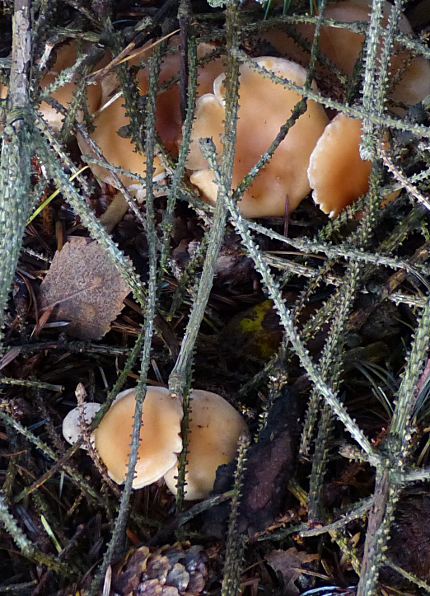
was very productive. On the left is another buttery-capped
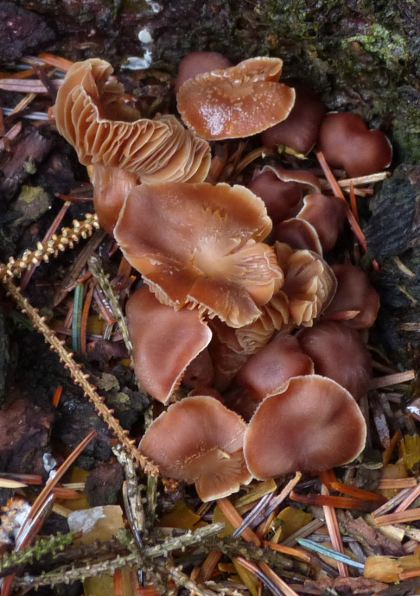
mushroom, the Tawny Funnel. I couldn't identify the ones on the
right but I'm including them as they look nice. I think they may be a Psathyrella species.
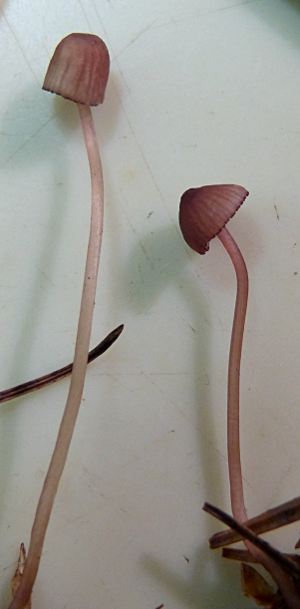
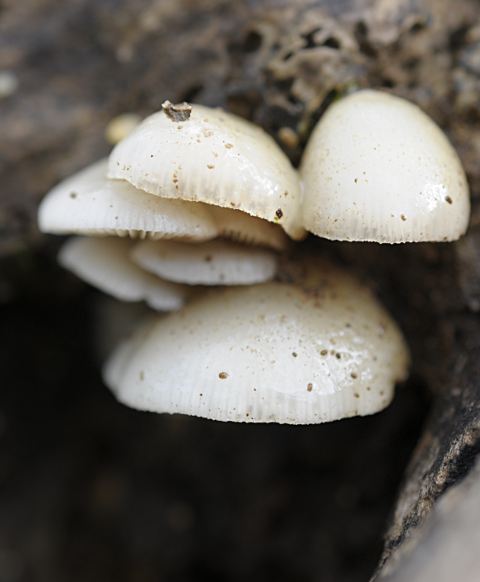
Two Mycenas found by Jan: M leptocephala on a mossy log
and M sanguinolenta from spruce needle litter (photo taken at home).
Across Loch Linnhe from the cycle track at Kentallen
Late-flowering Foxgloves on some waste ground next to the cycle
track.
Cheerful splashes of Orange Peel Fungus were frequent on disturbed
soil alongside the recently-laid track. It is common in such
situations but soon becomes crowded out by vegetation.
Once past Kentallen the cycle track crosses the open
hillside and so we were back in Waxcap Wander mode and found a number of
grassland fungi. There are fine views from this stretch of the
track, which ends at the Holly Tree Hotel.
Both these are in close-up to show the bobbles on them!
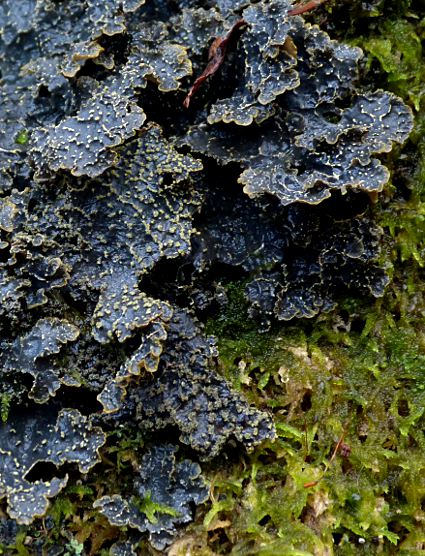
Scarlet Caterpillar Club, found by Jan on a mossy rock, and, very close
by, our old friend Rock Tripe. When we last saw this on our
28 Jan field trip, it was on coastal rock and it clearly
favoured places where water was running down the rock, in preference to
drier parts of the rockface. Yet here it was on an exposed outcrop that is only
wetted by direct rainfall and must dry out very quickly. Here is the list of all fungi found on the trip that I was able to identify.
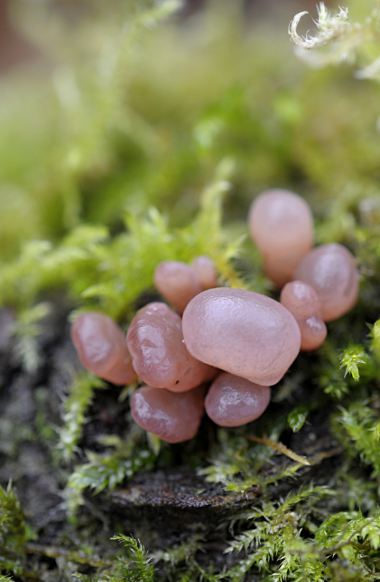
The Birch Jelly Buttons were very young and numerous on
a single birch tree. It was the earliest we've recorded them in
Argyll; presumably they were brought on by the extreme rain. The
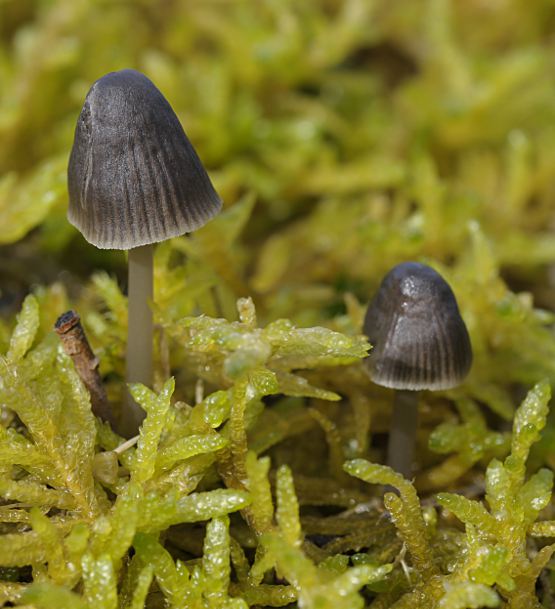
Blue Bonnet was a pleasing find on an alder stump. The Plums and
Custard was a very surprising sight in grassland a long way from any
trees or woody material, but it must have been growing on buried wood,
no matter how unlikely this seemed.
I picked up a fallen Alder leaf with an orange fuzz on
it and took it home thinking it might be a fungus, but in fact it was
the gall of the mite Acalitus brevitarsus. The young mites live
among the fuzz which under the microscope is seen to be made up of these
tree-like structures. It must be like living in a mini-forest,
with protection from sun and rain but plenty of room to walk about
underneath.
A final image from Jan, a photographer with the eye of a painter.
|